Hong Kong Master's Interview: Formats, What Panels Assess and How to Prepare
Not every Hong Kong taught master's programme interviews, and only shortlisted applicants are invited. Non-local applicants are usually interviewed by video. Here is what panels assess, common question types and how to prepare.
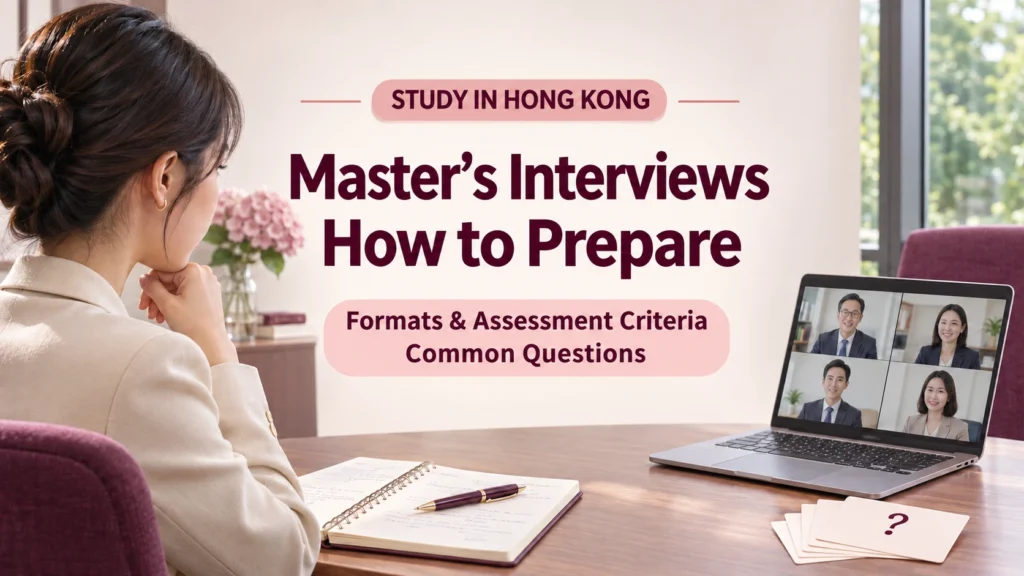
If you have applied for a taught master’s degree in Hong Kong, one of the first questions after submitting is whether there will be an interview and what it will cover. In short: not every programme interviews. Each programme decides for itself, and those that do interview invite only shortlisted applicants. An invitation means your documents have passed the first screening, and the conversation that follows often decides the final outcome.
Which Hong Kong master’s programmes interview?
The University of Hong Kong’s taught postgraduate FAQ states that not all programmes require an interview or test, and directs applicants to the relevant programme office. Judging from published admissions pages across the universities, business, education, social sciences, media and public policy programmes interview more often, while some science and engineering programmes rely mainly on documents and interview only selected applicants.
So not hearing about an interview is not necessarily bad news; the programme may simply not hold one. Check the “Admission” or “How to Apply” section of each target programme before you apply, and log in to the application system regularly.
Common interview formats
- Mostly video: HKUST’s postgraduate admission guidelines state that interviews should be held in person or by video conference, that phone interviews are not recommended, that the applicant’s identity must be verified first, and that panels should have at least two interviewers. Applicants outside Hong Kong should generally expect a video interview, but follow the invitation.
- Mostly individual: Most interviews are one applicant facing two or more faculty members. A few programmes add a group discussion or a written test, which the invitation will mention.
- Language: Taught master’s programmes in Hong Kong are mostly taught in English, so prepare in English unless the invitation says otherwise.
What interviewers look for
HKU’s Master of Social Sciences in Sustainability Leadership and Governance, for example, says shortlisted candidates may be interviewed online via Zoom and that the interview gauges applicants’ motivation, understanding of the field, communication skills and capacity for critical thinking. Emphasis varies by subject, but most panels look at the same four areas:
- Motivation: why this subject, why Hong Kong and why this university
- Subject knowledge: a working grasp of core concepts and the current state of the field
- Communication: explaining ideas clearly and logically in English
- Critical thinking: giving a reasoned view on an open question
Common question types
- Self-introduction: about one minute, focused on study, internships or projects relevant to the programme rather than a recital of your CV
- Motivation: Why this programme? Why Hong Kong? What are your career plans?
- Follow-ups on your experience: panels often probe an item from your personal statement or CV, such as your exact role in a project and the problems you solved
- Subject questions: fundamentals or current issues, such as recent market developments for finance applicants
- Scenarios and open questions: a real-world problem for you to analyse
- Your questions: most interviews end by inviting questions, so prepare one or two about the programme itself
HK VirtueLead Tips
- Build your preparation around your personal statement: most follow-up questions come from the documents you submitted. Prepare a one-minute spoken version of every experience in your statement and CV; it works far better than memorising generic answers. Our Hong Kong master’s application document checklist covers what those documents should contain.
- Test your setup in advance: the day before a video interview, install the software named in the invitation, check your connection, camera, microphone and lighting, and keep your passport or ID ready for identity checks.
- Watch your inbox and the calendar: invitations usually arrive by email, sometimes with short reply windows. Check your inbox daily during the application season, including the spam folder, keep track of Hong Kong master’s application deadlines, and avoid interview clashes if you apply to several universities.
Good preparation is not about memorising model answers but about showing a logical link between your experience and the programme. If spoken English is a weak point, start practising as soon as you submit, rather than waiting for an invitation; if your test scores are still short, see our comparison of IELTS and TOEFL requirements for Hong Kong master’s programmes.
For help with university choices and application planning, contact HK VirtueLead advisors through HK Life Hub.
References:
- The University of Hong Kong, Taught Postgraduate Admissions FAQ (accessed 5 November 2026) https://admissions.hku.hk/tpg/faq
- HKUST Fok Ying Tung Graduate School, PG Admission: Application and Selection (accessed 5 November 2026) https://pgadmission.hkust.edu.hk/pg-admission/application-and-selection
- HKU Centre for Civil Society and Governance, MSocSc in Sustainability Leadership and Governance admission page (accessed 5 November 2026) https://ccsg.hku.hk/slgp/admission/
Official source:https://admissions.hku.hk/tpg/faq